
Introduction: PAS-6 Applicability
Understanding PAS-6 applicability is crucial for companies dealing with share capital compliance in India. However, confusion still exists among professionals and business owners regarding when PAS-6 becomes mandatory.
Many assume that PAS-6 is required only when shares are dematerialized. However, this is not correct.
The applicability depends on a simple compliance logic:
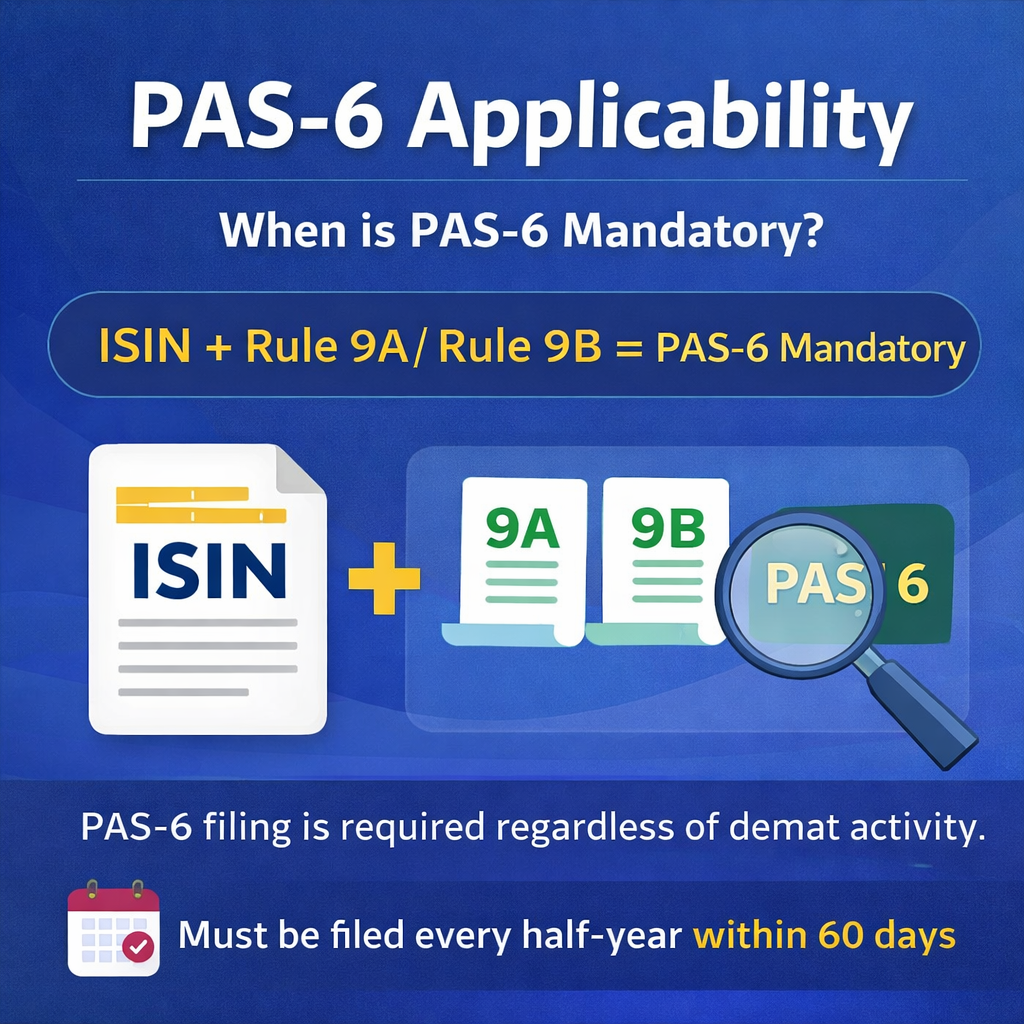
ISIN + Rule 9A / Rule 9B Applicability = PAS-6 Mandatory
Therefore, even if no shares are dematerialized, filing may still be required. This guide explains everything with practical, scenario-based clarity.
What is PAS-6?
PAS-6 is a reconciliation of the share capital audit report. It ensures consistency between:
- Physical share capital
- Dematerialized shares
- Total issued capital
- Depository records
In addition, it helps regulators monitor shareholding transparency and prevent discrepancies.
Basic Rule of PAS-6 Applicability
PAS-6 becomes mandatory when:
- The company has obtained an ISIN, and
- The company falls under Rule 9A applicability or Rule 9B applicability to a private company
Therefore, both conditions must be satisfied.
Simple Compliance Formula
- ISIN obtained
- Covered under Rule 9A or Rule 9B
PAS-6 filing is compulsory
Moreover, this rule applies regardless of demat activity.
PAS-6 Applicability for an Unlisted Public Company
Under Rule 9A applicability, every unlisted public company must:
- Facilitate dematerialisation of shares
- Obtain ISIN
- Maintain compliance with depositories
As a result, once an ISIN is obtained:
PAS-6 filing becomes mandatory
Key Insight:
Even if shareholders have not converted shares into demat form, PAS-6 must still be filed.
PAS-6 Applicability for a Private Company
The rules changed with the introduction of Rule 9B applicability to a private company.
Now:
- Private companies (other than small companies) must comply with dematerialization requirements.
- ISIN is required
Therefore, PAS-6 is mandatory after obtaining ISIN
PAS-6 Applicability to a Small Company
This is where most confusion arises.
Case 1: Small Company WITH ISIN
- ISIN may be obtained voluntarily.
- However, Rule 9A/9B does not apply.
PAS-6 is NOT mandatory
Case 2: Small Company WITHOUT ISIN
PAS-6 is not applicable
Hence, small companies are generally outside PAS-6 compliance unless regulations change.
PAS-6 Mandatory or Not?
|
Scenario |
PAS-6 Required? |
|
Unlisted Public Company with ISIN |
Yes |
|
Private Company (not small) with ISIN |
Yes |
|
Private Company (not small) without ISIN |
No (until ISIN obtained) |
|
Small Company with ISIN |
No |
|
Small Company without ISIN |
Not Applicable |
PAS-6 Due Date
Understanding the PAS-6 due date is essential to avoid penalties.
PAS-6 must be filed half-yearly within 60 days:
- April – September – Due by 29th November
- October – March – Due by 30th May
Timely filing ensures compliance and avoids legal complications.
PAS-6 Filing Process
The PAS-6 filing process involves the following steps:
Step 1: Obtain ISIN
Coordinate with a depository participant.
Step 2: Collect Share Capital Data
Gather details of:
- Physical shares
- Demat shares
- Issued capital
Step 3: Reconciliation
Match company records with depository data.
Step 4: Certification
The report must be certified by:
- Practicing Company Secretary, or
- Chartered Accountant
Step 5: File with MCA
Submit PAS-6 through the MCA portal.
Proper documentation is critical for smooth filing.
PAS-6 Penalty for Non-Filing
Non-compliance can lead to serious consequences.
Penalties include:
- Monetary fines on the company
- Penalties on officers in default
- Regulatory scrutiny
Therefore, timely filing is not optional—it is essential.
ISIN Requirement for PAS-6
The ISIN requirement for PAS-6 is the most critical trigger point.
Without ISIN:
- PAS-6 is not applicable
With ISIN + Rule 9A/9B:
- PAS-6 becomes mandatory
Hence, obtaining ISIN automatically increases compliance responsibility.
Practical Example for Better Understanding
Example 1:
A private company (not small) obtains an ISIN.
- Covered under Rule 9B
- PAS-6 required
Example 2:
An unlisted public company has an ISIN.
- Covered under Rule 9A
- PAS-6 mandatory
Example 3:
A small company voluntarily takes an ISIN.
- Rule 9A/9B not applicable
- PAS-6 not required
How R A Daga and Co. Can Help
As a professional company secretary firm, we assist with the following:
- PAS-6 applicability analysis
- ISIN advisory and coordination
- End-to-end filing support
- Compliance tracking and reminders
- Certification and documentation
Our goal is to simplify compliance and eliminate risks.
Conclusion
- PAS-6 applicability depends on ISIN + Rule 9A/9B
- It is not dependent on dematerialisation
- Private and unlisted public companies must comply once ISIN is obtained.
- Small companies are generally exempt.
Therefore, understanding this framework ensures smooth compliance.
Call us now: +91 80870 64602 or visit radaga.in/contact-us for quick assistance.