
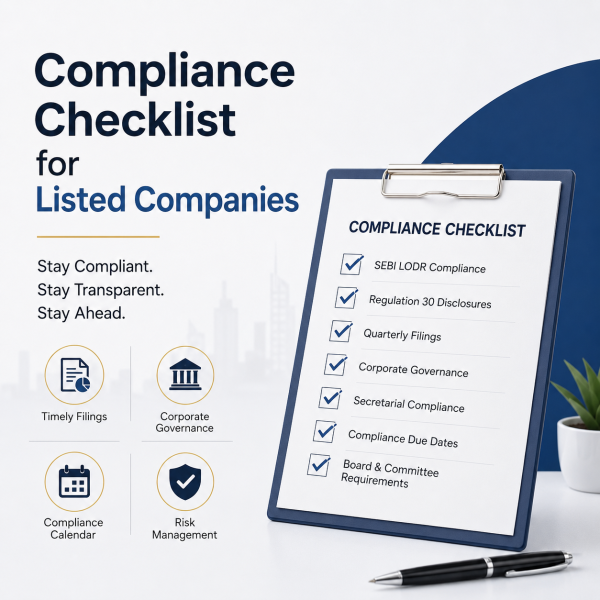
Introduction: Compliance checklist for listed companies
Listed companies in India operate under a strict regulatory framework. Therefore, maintaining proper compliance is not only a legal duty but also a key factor in protecting investor confidence and corporate reputation. A missed filing, delayed disclosure, or governance lapse can attract penalties from stock exchanges and regulatory authorities.
Companies must follow a structured compliance system covering disclosures, filings, board procedures, governance standards, and periodic reporting requirements.
Compliance checklist for listed companies, including SEBI LODR compliance checklist requirements, quarterly compliance obligations, corporate governance standards, and important disclosure timelines.
At R A Daga and Co., we assist listed entities with end-to-end secretarial compliance, SEBI advisory, governance management, and regulatory filing support.
Compliance Framework for Listed Companies
Every listed company in India must comply with multiple laws and regulations. These include:
- SEBI (Listing Obligations and Disclosure Requirements) Regulations, 2015
- Companies Act, 2013
- Secretarial Standards issued by ICSI
- Stock Exchange requirements
- Corporate governance norms
- Insider trading regulations
Moreover, listed entities must regularly submit disclosures to stock exchanges like NSE and BSE. These disclosures ensure transparency and investor protection.
Consequently, maintaining a proper listed company compliance calendar becomes essential for avoiding non-compliance risks.
Why a Compliance Checklist for Listed Companies Is Important
A proper compliance framework helps listed entities:
- Avoid penalties and regulatory action
- Maintain investor confidence
- Improve corporate governance
- Ensure timely disclosures
- Reduce operational risks
- Build transparency and accountability
In addition, companies with strong compliance systems often gain better credibility among investors, lenders, and market regulators.
Therefore, businesses should implement a structured SEBI compliance checklist for listed companies to monitor all due dates and obligations.
SEBI LODR Compliance Checklist for Listed Companies
The SEBI LODR Regulations form the backbone of listed entity compliance requirements in India. These regulations govern disclosure obligations, governance practices, reporting timelines, and shareholder communication.
Below is a practical SEBI LODR compliance checklist that listed companies should follow.
1. Board Meeting Intimation
Listed entities must inform stock exchanges in advance regarding board meetings.
Key requirements include:
- Prior intimation of board meetings
- Agenda disclosure for financial results
- Disclosure of dividend consideration
- Approval of fundraising proposals
Timely intimation is critical under SEBI regulations.
2. Submission of Financial Results
Quarterly and annual financial results must be submitted within prescribed timelines.
This includes:
- Quarterly standalone and consolidated results
- Limited review reports
- Annual audited financial statements
- Statement of assets and liabilities
- Cash flow statements
Delayed filing may lead to fines and stock exchange action.
Therefore, companies should maintain a proper listed company compliance calendar to track due dates efficiently.
3. Regulation 30 Disclosure Checklist
Regulation 30 disclosure checklist requirements are among the most important compliance obligations for listed entities.
Companies must disclose material events such as:
- Change in directors or KMP
- Mergers and acquisitions
- Litigation updates
- Fraud incidents
- Shareholder agreements
- Credit rating changes
- Resignation of auditors
- Business expansion decisions
Furthermore, disclosures must be accurate, timely, and filed within the prescribed time limit.
Failure to comply can significantly affect investor trust and regulatory standing.
Quarterly Compliance for Listed Companies
Quarterly compliance for listed companies involves recurring reporting obligations throughout the financial year.
Important Quarterly Compliances
Shareholding Pattern Filing
Companies must submit quarterly shareholding patterns under Regulation 31.
Corporate Governance Report
Listed entities must file governance reports under Regulation 27(2).
Reconciliation of Share Capital Audit
This audit ensures consistency between issued capital and depository records.
Investor Complaints Statement
Companies must disclose investor grievance status regularly.
Financial Results Filing
Quarterly financial statements must be submitted within specified deadlines.
As quarterly obligations are repetitive, businesses should maintain a detailed compliance due dates for listed companies tracker.
Annual Compliance Checklist for Listed Companies
Apart from quarterly obligations, listed companies must complete several yearly compliances.
Annual Compliance Requirements Include
- Annual Report preparation
- Secretarial Audit Report
- Corporate Governance Report
- Business Responsibility and Sustainability Reporting (BRSR)
- Annual General Meeting compliance
- MGT-7 filing
- AOC-4 filing
- CEO/CFO certification
- Dividend distribution compliance
Moreover, annual compliance activities require coordination among finance, legal, secretarial, and management teams.
Therefore, professional compliance management becomes highly important.
Corporate Governance Compliance Checklist
Strong governance practices are mandatory for listed entities.
A corporate governance compliance checklist generally includes:
Board Composition Compliance
Companies must ensure:
- Proper number of independent directors
- Woman director appointment
- Qualified board committees
Committee Formation
Mandatory committees include:
- Audit Committee
- Nomination & Remuneration Committee
- Stakeholders Relationship Committee
- Risk Management Committee
Related Party Transaction Compliance
Listed companies must disclose and approve related party transactions according to SEBI norms.
Vigil Mechanism
A whistleblower framework should be implemented for reporting unethical practices.
Good governance not only improves compliance but also strengthens market reputation.
Secretarial Compliance Checklist for Listed Companies
Secretarial compliance plays a major role in maintaining regulatory discipline.
At R A Daga and Co., we regularly assist companies with secretarial compliance checklist for listed companies requirements.
Key Secretarial Compliances Include
- Maintenance of statutory registers
- Board meeting documentation
- Drafting resolutions
- Minutes preparation
- Secretarial audit coordination
- Filing with MCA and stock exchanges
- Monitoring SEBI regulations
- Shareholder meeting management
In addition, proper secretarial systems help businesses avoid procedural lapses.
Listed Entity Compliance Requirements Under SEBI
The listed entity compliance requirements framework focuses on transparency and investor protection.
Important obligations include:
- Timely disclosures
- Financial transparency
- Governance reporting
- Insider trading compliance
- Shareholding disclosures
- Preservation of documents
- Website disclosures
- Material event reporting
Furthermore, SEBI regularly updates compliance norms. Hence, companies should continuously monitor regulatory changes.
Compliance Due Dates for Listed Companies
Tracking compliance due dates for listed companies is essential for preventing penalties.
Below are some common recurring timelines:
Compliance | Frequency |
Financial Results | Quarterly |
Shareholding Pattern | Quarterly |
Corporate Governance Report | Quarterly |
Investor Complaints Report | Quarterly |
Secretarial Compliance Report | Annual |
Annual Report Submission | Annual |
AGM Compliance | Annual |
BRSR Filing | Annual |
Since deadlines vary depending on regulations and market capitalization, companies should maintain a customized compliance calendar.
How Professional Compliance Support Helps Listed Companies
Professional advisory support helps listed entities streamline compliance operations.
At R A Daga and Co., we provide SEBI compliance services for listed companies with a practical and process-driven approach.
Our Services Include
- SEBI LODR compliance management
- Secretarial audit support
- Corporate governance advisory
- Stock exchange filing support
- Disclosure management
- Compliance calendar monitoring
- Board process management
- Drafting and documentation
- Regulatory advisory
Moreover, our team helps businesses reduce compliance risks while ensuring timely reporting and governance efficiency.
Best Practices for Managing Listed Company Compliance
To maintain smooth compliance operations, listed entities should follow these best practices:
Maintain a Compliance Calendar
A structured listed company compliance calendar prevents missed deadlines.
Conduct Internal Compliance Reviews
Periodic reviews help identify gaps before regulatory scrutiny arises.
Automate Compliance Tracking
Technology tools improve accuracy and reduce manual errors.
Train Compliance Teams
Regular updates on SEBI regulations improve operational efficiency.
Engage Professional Advisors
Expert advisory support ensures proper interpretation of evolving regulations.
Why Choose R A Daga and Co. for Listed Company Compliance Services
Managing listed entity compliance requires technical expertise, regulatory understanding, and timely execution.
At R A Daga and Co., we support listed companies with:
- End-to-end SEBI compliance management
- Secretarial compliance solutions
- Corporate governance advisory
- Regulatory filing assistance
- Compliance calendar monitoring
- Board and shareholder compliance support
Our practical approach helps companies maintain regulatory confidence while focusing on business growth.
Conclusion
A strong compliance framework is essential for every listed entity operating in India. From quarterly disclosures and governance reporting to annual filings and SEBI obligations, companies must manage multiple regulatory responsibilities throughout the year.
Therefore, implementing a detailed compliance checklist for listed companies helps businesses maintain transparency, avoid penalties, and strengthen investor trust.
With increasing regulatory scrutiny and evolving governance standards, professional compliance management has become more important than ever.
If your organization requires assistance with SEBI LODR compliance checklist management, disclosure filings, governance reporting, or secretarial compliance support, R A Daga and Co. can help you manage the entire compliance lifecycle efficiently.
Call us now: +91 80870 64602 or visit radaga.in/contact-us for quick assistance.