
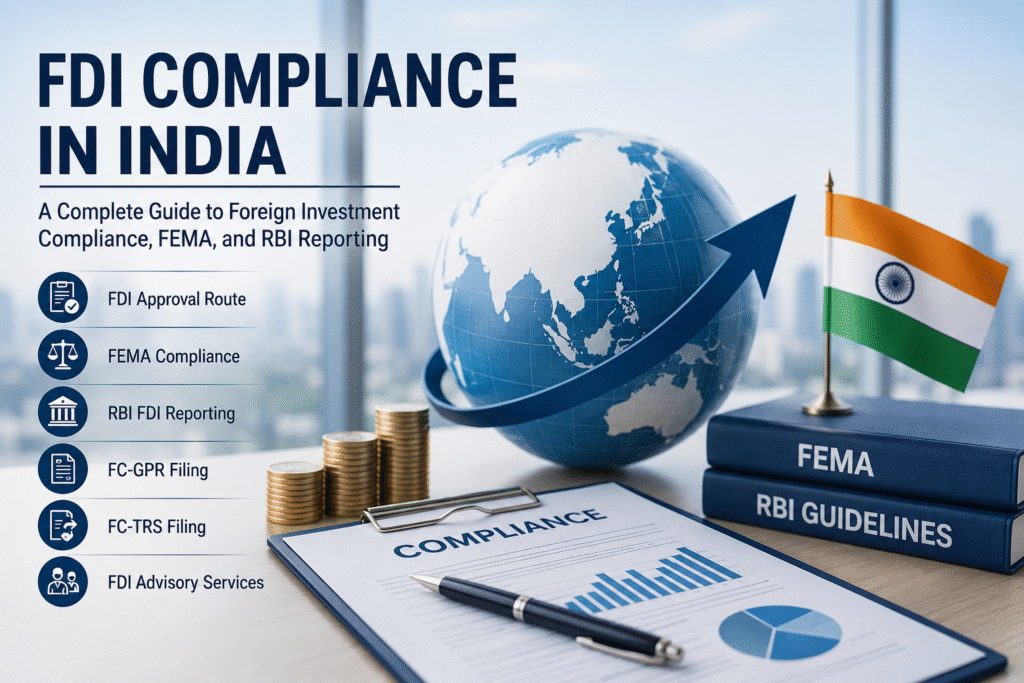
Introduction: FDI Compliance in India
Foreign investment continues to play a significant role in India’s economic growth. Every year, multinational companies, startups, private equity firms, venture capital investors, and overseas businesses invest billions of dollars across different sectors. However, receiving foreign investment is only the first step. Businesses must also ensure proper FDI Compliance in India to avoid regulatory issues, penalties, and delays.
India’s foreign investment framework is governed by the Foreign Exchange Management Act (FEMA), Reserve Bank of India (RBI) regulations, the Companies Act, 2013, and the Consolidated FDI Policy issued by the Government of India. Therefore, every company receiving foreign investment must comply with applicable reporting, documentation, and filing requirements.
At R A Daga & Co., we assist businesses with end-to-end FDI Advisory Services, ensuring every investment transaction complies with applicable laws and regulatory requirements.
What is FDI Compliance in India?
FDI Compliance in India refers to the legal, regulatory, and reporting obligations that companies must fulfill after receiving foreign investment. These obligations help maintain transparency while ensuring that foreign investments comply with FEMA, RBI guidelines, sectoral regulations, and company law requirements.
Compliance begins before the investment is received and continues throughout the investment lifecycle. Consequently, businesses should establish proper compliance procedures from the beginning.
Why is FDI Compliance Important?
Proper compliance protects businesses from unnecessary regulatory risks.
Some key benefits include:
- Avoiding penalties for delayed reporting
- Maintaining RBI and FEMA compliance
- Building investor confidence
- Supporting future fundraising activities
- Simplifying mergers, acquisitions, and due diligence
- Ensuring smooth cross-border transactions
- Reducing regulatory disputes
Furthermore, compliant businesses are more attractive to international investors and financial institutions.
Regulatory Framework for Foreign Direct Investment Compliance
Several laws regulate foreign investment in India.
These include:
- Foreign Exchange Management Act (FEMA)
- RBI Master Directions
- Consolidated FDI Policy
- Companies Act, 2013
- Applicable sector-specific regulations
- Pricing Guidelines
- Foreign Exchange Management (Non-Debt Instruments) Rules
Since multiple authorities oversee foreign investments, businesses should seek professional guidance before completing any transaction.
Key Components of FDI Compliance in India
1. Entry Route Analysis
Before accepting foreign investment, companies must determine whether the investment falls under the:
- Automatic Route
- Government Approval Route
Understanding the correct FDI Approval Route helps businesses avoid regulatory violations from the beginning.
2. FEMA Compliance Services
Foreign investments are governed primarily by FEMA regulations.
Professional FEMA Compliance Services generally include:
- FEMA advisory
- Transaction structuring
- Share issuance compliance
- Pricing guideline verification
- Investment documentation
- Regulatory approvals
- Ongoing compliance support
Proper FEMA compliance reduces future legal and financial risks.
3. RBI FDI Reporting
Every eligible foreign investment transaction requires timely reporting to the Reserve Bank of India through the prescribed reporting system.
RBI FDI Reporting generally includes:
- Reporting of foreign investment
- Share allotment reporting
- Share transfer reporting
- Delay regularisation where applicable
- Supporting documentation
- Compliance verification
Timely reporting helps companies maintain a clean regulatory record.
4. FC-GPR Filing
One of the most important post-investment compliances is FC-GPR Filing.
This filing is required after issuing shares to a foreign investor.
The filing generally includes:
- Board Resolution
- Valuation Certificate
- KYC of Investor
- Foreign Inward Remittance Certificate (FIRC)
- Company Secretary certification where applicable
- Statutory declarations
Accurate filing prevents unnecessary delays and compliance notices.
5. FC-TRS Filing
Whenever shares are transferred between a resident and a non-resident, FC-TRS Filing becomes essential.
This filing covers:
- Share purchase transactions
- Share sale transactions
- Transfer documentation
- Pricing compliance
- FEMA declarations
- RBI reporting requirements
Professional review ensures the filing complies with FEMA provisions.
Foreign Investment Advisory for Startups and Growing Companies
Many startups receive investments from overseas investors.
Professional Foreign Investment Advisory becomes valuable during:
- Seed funding
- Angel investments
- Venture capital funding
- Private equity investment
- Strategic investments
- Cross-border mergers
- Business expansion
Early compliance planning helps avoid complications during future funding rounds.
Why Choose a Company Secretary for FDI Compliance?
A Company Secretary plays an important role in maintaining regulatory compliance throughout the investment process.
Professional support helps businesses:
- Interpret FEMA regulations
- Maintain statutory records
- Prepare board documentation
- Coordinate regulatory filings
- Ensure secretarial compliance
- Support investor due diligence
- Reduce compliance risks
- Maintain proper corporate governance
Therefore, engaging an experienced FDI Consultant in India helps businesses manage both legal and procedural requirements effectively.
How R A Daga & Co. Supports Businesses
At R A Daga & Co., we provide comprehensive compliance support for businesses receiving foreign investment.
Our services include:
- FDI Advisory Services
- FEMA Advisory Services
- Foreign Direct Investment Compliance
- RBI FDI Reporting
- FC-GPR Filing assistance
- FC-TRS Filing assistance
- Secretarial Compliance
- Corporate Governance Support
- Investment Documentation
- Regulatory Advisory
- Foreign Investment Advisory
Our objective is to help businesses remain compliant while facilitating smooth investment transactions.
Conclusion
Maintaining FDI Compliance in India is essential for every company receiving foreign investment. From understanding the correct FDI Approval Route to completing RBI FDI Reporting, FC-GPR Filing, FC-TRS Filing, and complying with FEMA regulations, each step requires careful planning and timely execution.
Professional guidance can help businesses reduce compliance risks, avoid delays, and maintain strong corporate governance. Whether you are a startup, an established company, or an overseas investor, partnering with experienced professionals can simplify complex compliance requirements.
R A Daga & Co. offers end-to-end support for foreign investment compliance, helping businesses confidently navigate India’s regulatory framework while focusing on long-term growth.
Call us now: +91 80870 64602 or visit radaga.in/contact-us for quick assistance.