
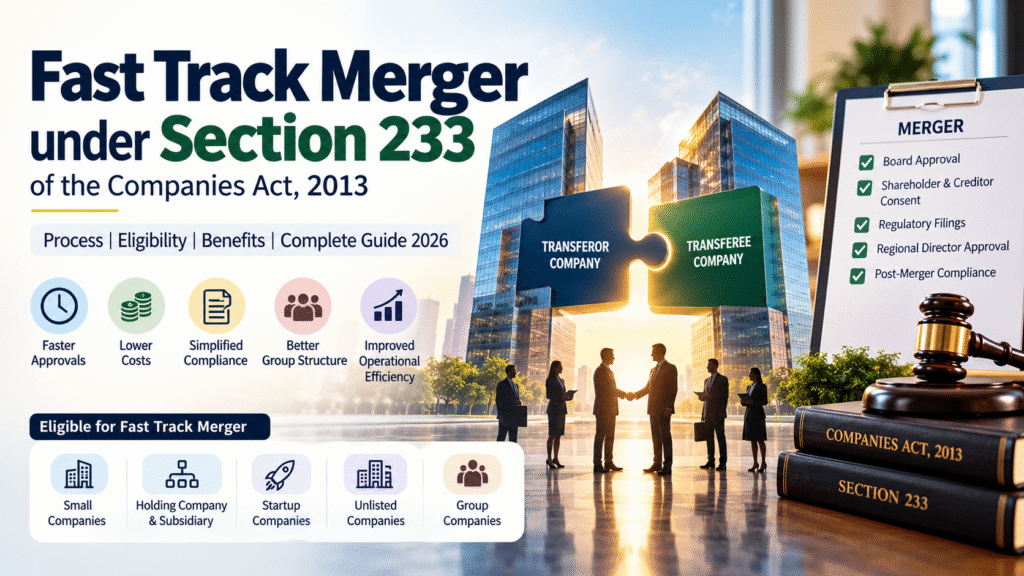
Introduction: Fast Track Merger under Section 233
Corporate restructuring has become a strategic necessity for many businesses in India. Companies are looking for faster, more efficient ways to consolidate operations, reduce compliance burdens, improve profitability, and strengthen group structures. As a result, the Fast-Track Merger under Section 233 of the Companies Act, 2013 has emerged as one of the most effective mechanisms for eligible companies.
Moreover, the 2025 amendments expanded the scope of eligible entities, making the Fast-Track route more attractive for startups, unlisted companies, holding-subsidiary structures, and group companies. Consequently, businesses can now complete mergers through a streamlined approval process without undergoing lengthy National Company Law Tribunal (NCLT) proceedings in many eligible cases.
We explain the eligibility criteria, benefits, process, documentation requirements, and practical considerations of a Fast-Track Merger in 2026 and beyond.
What Is a Fast-Track Merger Under Section 233?
A Fast-Track Merger is a simplified merger mechanism provided under Section 233 of the Companies Act, 2013 and Rule 25 of the Companies (Compromises, Arrangements and Amalgamations) Rules.
Unlike conventional merger schemes that often require NCLT approval, eligible companies can obtain approval through the Regional Director and regulatory authorities. Therefore, the process is generally quicker, less expensive, and more efficient.
The objective is simple: facilitate business restructuring while maintaining regulatory oversight and stakeholder protection.
Which Companies Are Eligible for Fast Track Merger?
Following recent regulatory developments, the scope of eligible entities has widened considerably.
Eligible categories include:
- Small Companies
Two or more small companies can merge through the Fast-Track route if they satisfy the prescribed conditions.
- Holding Company and Wholly Owned Subsidiary
A Holding Company Subsidiary Merger remains one of the most common Fast Track transactions in India.
- Startup Company Merger
A Startup Company Merger involving eligible startup entities can utilize the Fast-Track framework, making restructuring easier for founders and investors.
- Unlisted Company Merger
The expanded framework now allows certain categories of Unlisted Company Merger transactions to proceed through the Fast-Track mechanism, subject to prescribed conditions.
- Group Company Restructuring
Businesses with multiple entities often use Fast Track mergers for Group Company Restructuring, consolidation, and operational efficiency.
Section 233 Merger Process with R A Daga and Co.
Understanding the Section 233 Merger Process is essential for promoters, directors, and management teams.
Step 1: Determine Eligibility
First, companies must confirm that they fall within the prescribed Fast Track categories.
At this stage, engaging a Fast-Track Merger Consultant can help identify legal, regulatory, and tax implications early in the process.
Step 2: Appoint Professionals
Companies typically engage:
- Chartered Accountants
- Registered Valuers
- Legal Advisors
- Company Secretaries
- Corporate Restructuring Consultants
Professional support ensures compliance throughout the merger lifecycle.
Step 3: Prepare Valuation and Merger Scheme
A valuation report is prepared to determine the share exchange ratio and support the merger scheme.
Step 4: Board Approval
The Board of Directors of each company reviews and approves:
- Draft Scheme of Merger
- Valuation Report
- Declaration of Solvency
- Statutory filings
Step 5: Issue Notices and Regulatory Filings
Relevant notices are submitted to:
- Registrar of Companies (ROC)
- Official Liquidator (OL)
- Income Tax Authorities
- Other regulators, where applicable
Step 6: Approval from Members and Creditors
The merger scheme must receive the required approvals from shareholders and creditors.
Step 7: Filing with Regional Director
The approved scheme is submitted to the Regional Director along with prescribed forms and supporting documents.
Step 8: Final Confirmation and Implementation
After approval, companies complete post-merger filings and implement the scheme.
Fast Track Amalgamation vs Traditional Merger
Many business owners ask whether a Fast-Track Amalgamation is better than a conventional merger.
The answer depends on eligibility.
Parameter | Fast Track Merger | Traditional Merger |
Approval Authority | Regional Director | NCLT |
Timeline | Faster | Longer |
Compliance Burden | Lower | Higher |
Cost | Lower | Higher |
Suitable For | Eligible Companies | All Companies |
Therefore, eligible businesses often choose the Fast-Track route whenever possible.
Why Businesses Need Merger Advisory Services
Although the process is simplified, mergers still involve legal, accounting, tax, valuation, and compliance considerations.
Professional Merger Advisory Services help businesses:
- Evaluate eligibility
- Structure transactions efficiently
- Prepare documentation
- Manage regulatory interactions
- Handle tax implications
- Ensure post-merger compliance
An experienced Company Merger Consultant can significantly reduce execution risks and delays.
FAQs
What is a Fast-Track Merger under Section 233?
It is a simplified merger mechanism available to eligible companies under the Companies Act, 2013, allowing approval through the Regional Director instead of the NCLT.
Who can apply for a Fast-Track Merger?
Eligible entities include small companies, startup companies, holding-subsidiary structures, certain unlisted companies, and other prescribed categories.
Is NCLT approval required?
Generally, eligible Fast Track mergers proceed through the Regional Director approval process rather than the NCLT route.
What documents are required?
Typical documents include valuation reports, merger schemes, declarations of solvency, board resolutions, and prescribed MCA forms.
Why should I engage a Fast-Track Merger Consultant?
A consultant helps ensure compliance, proper structuring, timely filings, and smooth execution of the merger process.
Conclusion
The Fast-Track Merger under Section 233 has become an important tool for business consolidation, restructuring, and growth. With expanded eligibility and streamlined procedures, companies now have greater flexibility to optimize corporate structures while reducing compliance burdens.
However, successful implementation requires careful planning, valuation analysis, stakeholder management, and regulatory compliance. Therefore, businesses should seek professional
R A Daga and Co. provides comprehensive support for Fast Track Mergers, Corporate Restructuring, Company Amalgamations, Valuation Coordination, Regulatory Filings, and Merger Advisory Services.
Whether you are considering a Holding Company Subsidiary Merger, Startup Company Merger, Unlisted Company Merger, or broader Group Company Restructuring initiative, our professionals can help you evaluate eligibility, manage compliance, and execute the transaction efficiently.
Call us now: +91 80870 64602 or visit radaga.in/contact-us for quick assistance.