
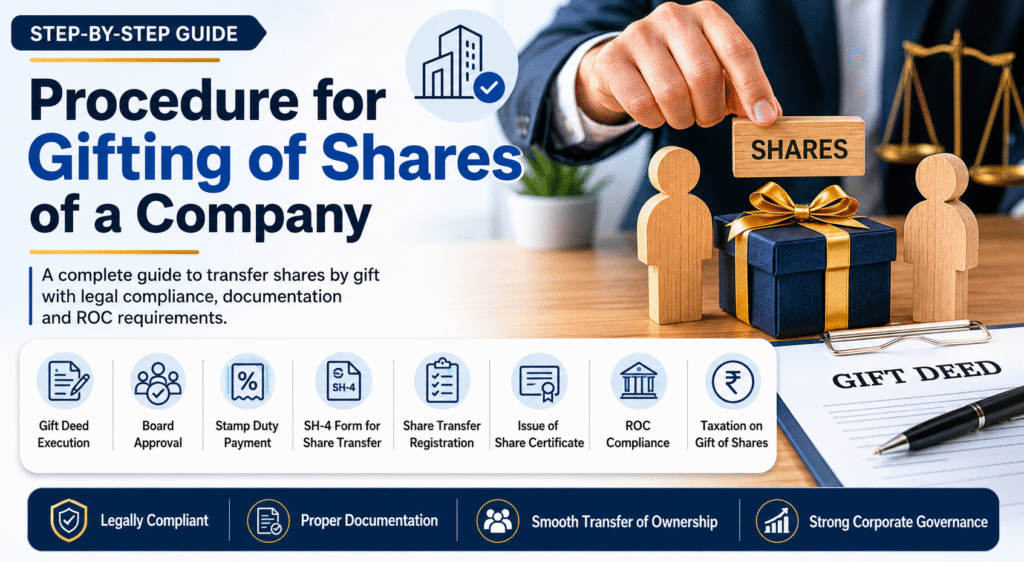
Introduction: Procedure for gifting of shares of a company
The procedure for gifting of shares of a company is becoming increasingly common among promoters, family-owned businesses, startup founders, and investors in India. Many shareholders transfer shares to family members, legal heirs, or business successors through a gift arrangement instead of a sale transaction.
However, the transfer of shares by gift is not merely a personal arrangement. It involves proper legal documentation, compliance under the Companies Act, stamp duty payment, board approval, and updating statutory records. If the process is not completed correctly, companies may face future disputes, compliance risks, or rejection of transfer requests.
At R A Daga and Co., we assist companies, promoters, and shareholders with end-to-end corporate compliance, share transfer documentation, secretarial advisory, and regulatory filings under the Companies Act, 2013.
We explain the complete procedure for gifting shares of a company in India, along with legal requirements, taxation, documentation, and compliance obligations.
What is the Gift of Shares?
A gift of shares refers to the voluntary transfer of ownership of shares from one person to another without consideration. In simple words, the shareholder transfers shares without receiving money in return.
Generally, gifting of shares takes place:
- Between family members
- During succession planning
- For promoter restructuring
- For estate planning
- For internal business restructuring
Since there is no sale consideration involved, the transaction is treated differently from a normal share sale transaction.
However, companies must still comply with:
- Companies Act, 2013
- Articles of Association (AOA)
- Stamp Act provisions
- Secretarial compliance requirements
Procedure for Gifting of Shares of a Company
The procedure for gifting of shares of a company involves several legal and procedural steps. Companies should maintain proper documentation to avoid future legal disputes.
Step 1: Verify Articles of Association (AOA)
Before initiating the transfer, the company must check whether its Articles of Association permit the transfer of shares through a gift.
In many private limited companies, share transfer restrictions exist. Therefore, the company should verify:
- Pre-emption rights
- Transfer restrictions
- Board approval conditions
- Existing shareholder agreements
If restrictions apply, approvals may be required before proceeding.
Step 2: Draft the Gift Deed for Transfer of Shares
A Gift deed for transfer of shares is one of the most important documents in the entire process.
The gift deed should clearly mention:
- Name of donor and donee
- Number of shares transferred
- Folio number
- Share certificate details
- Company name
- Relationship between parties
- Declaration that transfer is without consideration
The deed should also state that the transfer is voluntary and irrevocable.
A properly drafted gift deed helps establish legal ownership and protects both parties in future disputes.
Importance of a Gift Deed
The gift deed serves as:
- Legal evidence of transfer
- Proof of ownership transfer
- Compliance support document
- Internal corporate record
Many companies face legal complications because they fail to maintain proper documentation during share gifting transactions.
Therefore, professional drafting is highly recommended.
Step 3: Execute SH-4 Form for Share Transfer
The SH-4 form for share transfer is a mandatory transfer instrument prescribed under the Companies Act.
The form should include:
- Transferor details
- Transferee details
- Share details
- Distinctive numbers
- Execution date
- Witness signature
The transferor and transferee must sign the form properly.
Incomplete or incorrect SH-4 forms may lead to rejection of transfer requests by the company.
Step 4: Payment of Stamp Duty on Gift of Shares
Many people assume that no stamp duty applies when shares are transferred through a gift. However, stamp duty on gift of shares depends upon the applicable state laws and nature of transfer.
For physical shares:
- Stamp duty may apply on transfer instruments
For demat shares:
- Depository procedures may apply separately
Proper calculation and payment of stamp duty are essential because unstamped documents may become legally invalid.
Companies should maintain:
- Stamp duty proof
- Executed transfer documents
- Supporting declarations
Board Approval for Transfer of Shares
After document execution, the company must place the transfer request before the Board of Directors.
The Board approval for transfer of shares is an important compliance requirement under the Companies Act and the Articles of Association.
During the board meeting:
- Transfer documents are verified
- Share certificates are checked
- Compliance with AOA is reviewed
- Board resolution is passed
The board resolution should clearly approve:
- Transfer of shares
- Name of transferee
- Number of shares transferred
- Cancellation of old share certificate
- Issue of new share certificate
Step 6: Submission of Documents to the Company
The transferor or transferee must submit:
- Executed gift deed
- SH-4 form
- Original share certificate
- Identity proof
- PAN details
- Stamp duty proof
The company secretary or compliance officer should verify all documents carefully before registration.
Transfer of Shares Without Consideration
A transfer of shares without consideration is legally valid when it is structured as a genuine gift transaction.
However, authorities may scrutinize transactions if:
- The transfer appears artificial
- The purpose is tax avoidance
- Documentation is incomplete
- Beneficial ownership remains unclear
Therefore, companies should maintain:
- Proper board records
- Gift declarations
- Supporting resolutions
- Statutory register updates
Professional compliance support helps reduce future litigation risks.
Step 7: Registration of Share Transfer
After approval, the company records the transfer in:
- Register of Members
- Share transfer register
- Beneficial ownership records
The company officially recognizes the donee as the new shareholder only after registration.
This is a critical step in the gift of shares procedure in a private limited company.
Step 8: Issue of New Share Certificate
Once the transfer is registered, the company must issue a new share certificate in the name of the transferee.
The certificate should contain:
- Shareholder name
- Number of shares
- Certificate number
- Distinctive numbers
- Company seal and signatures
The old certificate should be cancelled as per company procedures.
ROC Compliance After Share Transfer
ROC compliance after share transfer is another important aspect of corporate governance.
Although private share transfers generally do not require direct ROC filing, companies must ensure:
- Statutory registers are updated
- Annual return reflects revised shareholding
- Beneficial ownership disclosures are updated
- Secretarial records remain accurate
Incorrect records may create compliance issues during:
- Due diligence
- Funding rounds
- IPO preparation
- Secretarial audit
- MCA inspections
Therefore, proper post-transfer compliance is essential.
Taxation on Gift of Shares in India
Taxation on gift of shares in India depends upon:
- Relationship between parties
- Fair market value
- Nature of shares
- Residential status
- Income Tax Act provisions
Generally, gifts received from specified relatives are exempt from tax under the Income Tax Act.
However, tax implications may arise when:
- Shares are gifted to non-relatives
- Threshold limits are crossed
- Future capital gains are calculated
Additionally:
- Clubbing provisions may apply
- Capital gains implications may arise during future sale
Therefore, tax planning should always accompany share gifting transactions.
Professional consultation helps avoid unnecessary tax exposure.
Why Proper Compliance Matters
A legally compliant share gifting process helps:
- Avoid shareholder disputes
- Maintain clean corporate records
- Improve governance standards
- Simplify future due diligence
- Support succession planning
- Strengthen investor confidence
Proper compliance also becomes extremely important for:
- Startups
- Family businesses
- Growing private companies
- Companies planning fundraising or IPO
Conclusion
The procedure for gifting of shares of a company requires careful planning, proper documentation, and strict legal compliance. Although the transaction may appear simple, companies must follow the correct process under the Companies Act and applicable regulations.
From executing the gift deed for transfer of shares to obtaining board approval for transfer of shares, paying stamp duty on gift of shares, filing SH-4 form for share transfer, and maintaining ROC compliance after share transfer, every step plays an important role.
Additionally, businesses should carefully evaluate the taxation on gift of shares in India before completing the transaction.
A professionally managed compliance process helps companies avoid future disputes, maintain accurate statutory records, and strengthen corporate governance.
If your company requires assistance with the gift of shares procedure in a private limited company, corporate secretarial compliance, or share transfer advisory, R A Daga and Co. can help you with complete end-to-end support under the Companies Act, 2013.
Call us now: +91 80870 64602 or visit radaga.in/contact-us for quick assistance.