
Introduction: GST Compliance Checklist
As the financial year approaches its end, businesses across India must ensure that their GST obligations are properly fulfilled. A well-structured GST Compliance Checklist helps businesses avoid penalties, interest, and regulatory scrutiny.
The end of the financial year is not only about closing accounts. It is also the time to review tax records, reconcile GST returns, and ensure compliance with statutory requirements. Therefore, following a GST Year End Compliance Checklist becomes essential for every business registered under GST.
For companies, MSMEs, and startups, completing GST compliance before 31 March ensures that their tax filings remain accurate and transparent. Moreover, businesses that follow a structured compliance process can easily avoid mismatches and future notices from tax authorities.
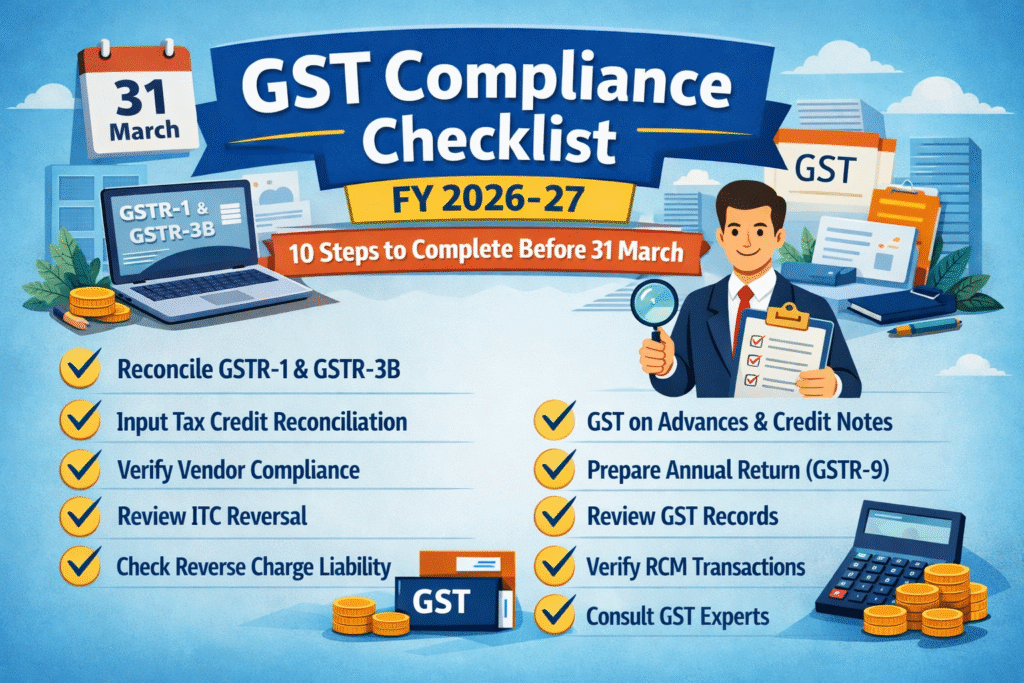
GST Compliance Checklist FY 2026-27 with ten critical steps every business must follow before the financial year ends.
Why GST Compliance Before 31 March is Important
GST compliance plays a vital role in maintaining financial transparency and regulatory adherence. Businesses that delay compliance often face penalties, interest liabilities, and potential audit risks.
A proper GST Compliance Checklist for Businesses helps organizations achieve the following:
- Ensure accurate GST return filings
- Identify errors before submitting annual returns
- Reconcile Input Tax Credit (ITC) properly
- Avoid penalties and notices from GST authorities
- Maintain accurate financial reporting
Furthermore, year-end compliance allows businesses to prepare accurate financial statements and ensure smooth audit processes.
GST Compliance Checklist FY 2026-27
Below are the 10 most important GST compliance checks that businesses must complete before 31 March.
1. Reconcile GSTR-1 and GSTR-3B Returns
One of the most critical tasks in any GST Return Filing Checklist is ensuring that the details reported in GSTR-1 and GSTR-3B match correctly.
Businesses should perform GSTR-1 and GSTR-3B reconciliation to verify that:
- Sales reported in GSTR-1 match the summary in GSTR-3B
- Tax liability has been correctly reported
- No invoices are missing or duplicated
If mismatches occur, businesses must rectify them in upcoming returns before the financial year closes.
2. Perform Input Tax Credit Reconciliation
Input Tax Credit Reconciliation GST is another crucial step in the year-end compliance process.
Businesses must reconcile:
- Purchase register
- GSTR-2B auto-generated statement
- ITC claimed in GSTR-3B
This ensures that businesses claim only eligible input tax credit. Therefore, any ineligible or excess ITC should be reversed before filing the final returns.
3. Verify Vendor Compliance
Many businesses lose input tax credit because vendors fail to file GST returns on time.
Hence, companies should verify:
- Vendor GST return filing status
- Invoice reporting in GSTR-1
- Tax payment confirmation
Vendor reconciliation helps businesses protect their input tax credit eligibility and maintain accurate GST records.
4. Review ITC Reversal for Unpaid Invoices
GST law requires businesses to reverse input tax credit if supplier invoices remain unpaid for more than 180 days.
Therefore, businesses must review:
- Outstanding vendor invoices
- ITC claimed against unpaid invoices
If invoices exceed the allowed time limit, ITC reversal must be done in GST returns.
5. Verify Reverse Charge Mechanism (RCM) Liability
Certain transactions fall under the Reverse Charge Mechanism (RCM). In such cases, the recipient must pay GST instead of the supplier.
Businesses should review transactions involving:
- Legal services
- Goods transport agencies
- Import of services
RCM compliance ensures proper tax reporting and avoids penalties.
6. Check GST Liability on Advances
Businesses receiving advances for goods or services must ensure proper GST treatment.
Therefore, organizations must verify:
- GST payment on advances
- Adjustment against final invoices
This ensures that GST liabilities are accurately reflected in returns.
7. Verify GST on Credit Notes and Debit Notes
Credit notes and debit notes affect the tax liability of a business. Hence, companies must review these documents before the financial year closes.
The review should include:
- Sales returns adjustments
- Pricing revisions
- Discount adjustments
Accurate reporting ensures that GST liability remains correct and transparent.
8. Prepare for GST Annual Return
Businesses must prepare their GST Annual Return Checklist to ensure accurate filing of annual returns such as GSTR-9 and GSTR-9C.
The preparation includes:
- Reconciling turnover data
- Matching financial statements with GST returns
- Verifying ITC claimed during the year
Preparing early helps businesses avoid last-minute compliance challenges.
9. Review GST Records and Documentation
Proper documentation is essential for GST compliance. Businesses should maintain detailed records including:
- Tax invoices
- Purchase records
- GST return filings
- Input tax credit documents
Maintaining organized documentation simplifies future audits and compliance reviews.
10. Consult GST Experts for Compliance Review
Even well-managed businesses sometimes miss compliance details. Therefore, consulting professional advisors helps ensure complete compliance.
Professional GST Compliance Services India help businesses:
- Review GST returns
- Conduct reconciliation checks
- Identify compliance risks
- Prepare annual returns
Similarly, expert GST Advisory Services can guide businesses on tax planning and compliance strategies.
Common GST Compliance Mistakes Businesses Must Avoid
Despite having structured compliance systems, many businesses still make common GST errors.
These include:
- Incorrect ITC claims
- Mismatch between returns
- Failure to reverse ineligible credits
- Late GST return filing
Therefore, businesses must review their GST Compliance Checklist FY 2026-27 carefully before submitting returns.
What a Professional GST Compliance Services Help Businesses
Many organizations prefer to outsource compliance tasks to professionals. Professional firms provide comprehensive GST Compliance Services India that simplify complex regulatory requirements.
A professional compliance partner can help with:
- GST return filing
- Input tax credit reconciliation
- GST audit preparation
- Compliance risk assessment
For growing businesses, professional GST Advisory Services ensure that tax compliance aligns with overall financial strategies.
Why Businesses Should Follow a Structured GST Compliance Checklist
A structured GST Compliance Checklist for Businesses provides several advantages.
First, it reduces compliance risks and ensures that all filings remain accurate. Second, it helps businesses avoid unnecessary penalties and interest charges. Third, it strengthens financial transparency and audit readiness.
Furthermore, a well-planned compliance process improves operational efficiency and regulatory confidence.
How R A Daga and Co. Supports GST Compliance
R A Daga and Co. provides professional compliance and advisory support to businesses across various industries.
Our services include:
- GST compliance review
- GST return filing and reconciliation
- Input tax credit verification
- GST audit support
- Regulatory advisory services
With extensive experience in regulatory compliance, our team ensures that businesses remain compliant with GST regulations and avoid costly mistakes.
Conclusion: GST Compliance Checklist
Completing the GST Compliance Checklist FY 2026-27 before 31 March is essential for every business registered under GST. Proper reconciliation, accurate return filing, and compliance verification help businesses avoid penalties and maintain financial transparency.
Moreover, following a structured GST Year End Compliance Checklist ensures that all GST obligations are fulfilled before closing the financial year.
Businesses that prioritize compliance not only avoid regulatory issues but also strengthen their financial governance.
If your business requires professional assistance with GST compliance, expert advisory support can help ensure accurate filings and complete regulatory compliance.
FAQs
What is a GST Compliance Checklist?
A GST Compliance Checklist is a structured list of tasks businesses must complete to ensure proper GST return filing, tax reconciliation, and regulatory compliance.
Why is GST compliance important before 31 March?
Completing GST compliance before 31 March ensures accurate financial reporting and helps businesses avoid penalties or audit risks.
What is ITC reconciliation in GST?
Input Tax Credit reconciliation involves matching purchase records with GSTR-2B and GST returns to verify eligible tax credits.
What returns must businesses reconcile for GST compliance?
Businesses must reconcile GSTR-1, GSTR-3B, and financial records before preparing annual returns like GSTR-9.
Should businesses hire GST consultants?
Professional GST advisory services help businesses avoid compliance errors and maintain accurate GST filings.
Call us now: +91 80870 64602 or visit radaga.in/contact-us for quick assistance.