
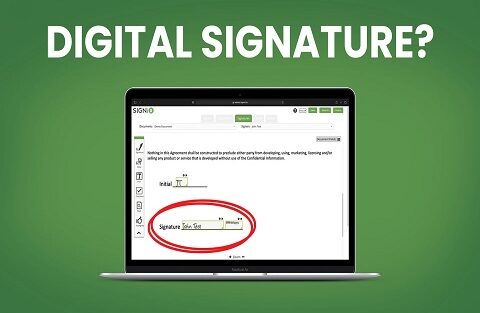
What is a Digital Signature Certificate (DSC)?
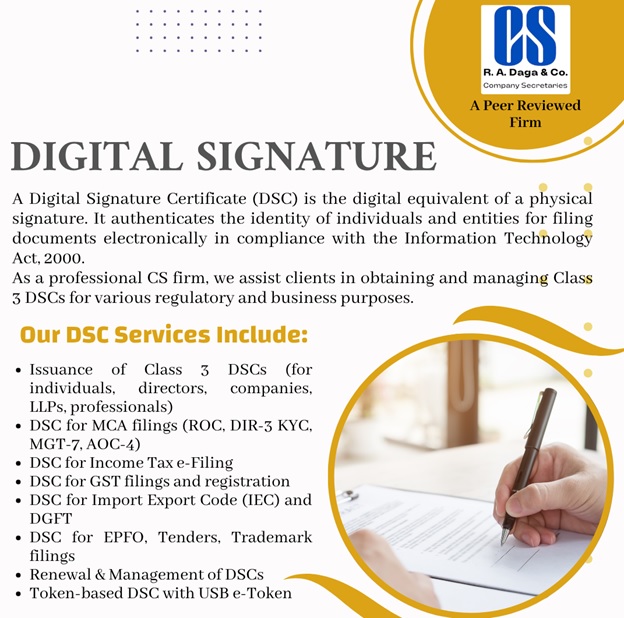
A Digital Signature Certificate is a secure, encrypted digital key used to verify and authenticate the identity of a person signing an electronic document. It is legally recognised under the Information Technology Act, 2000, and is accepted by all major regulatory authorities in India.
Unlike traditional signatures, a DSC ensures:
- Identity authentication
- Data security
Non-repudiation and legal validity
Where is a Digital Signature Required?
A DSC is required for a wide range of business-related filings and services, such as:
- MCA filings (INC forms, DIR, MGT, AOC, PAS, SH, CHG, etc.)
- Income Tax and TDS return submissions
- GST registration and filing
- Import-Export Code (IEC) applications
- Trademark and Intellectual Property filings
- Online bidding, tendering, and procurement
- Signing e-agreements and corporate documents
For any filing on the MCA V3 portal, a valid DSC is now mandatory.
Who Needs a DSC in a Company?
Typically, the following persons in a company need a valid DSC:
- Directors (for DIN, incorporation, and approval filings)
- Authorised Signatories (for GST, Income Tax, and IEC applications)
- Company Secretaries or professionals (for certification and attestation)
- Partners in LLPs
Even private companies and startups must ensure at least one director or authorized representative holds a valid DSC for e-filing purposes.
Types of Digital Signatures
DSC Type | Purpose |
Class 3 (Sign Only) | Most common for MCA, GST, and tax filings |
Class 3 (Sign & Encrypt) | Used in e-tendering and transactions requiring confidentiality |
All MCA and regulatory filings now accept only Class 3 DSCs, replacing earlier lower classes.
Expanded Use of DSC in Government Filings
All forms on the MCA Version-3 portal require a DSC, including:
- Director-related filings like DIR-3 KYC, DIR-12
- Share capital and compliance forms such as SH-7, PAS-3
- Financial statements (AOC-4) and annual returns (MGT-7)
- Charge filings (CHG-1, CHG-4, CHG-9)
- Incorporation forms (SPICe+, e-MoA, e-AoA)
No e-form is accepted without being authenticated using a valid Digital Signature.
How to Get a Digital Signature (via PantaSign)
Steps to Obtain a DSC:
- Choose a Certifying Authority (CA)
We work with trusted CAs like eMudhra, Sify, Capricorn, and NSDL. - Submit Required Documents
- PAN & Aadhaar of the applicant
- Passport-sized photograph
- Address proof
- Company authorisation letter (if applicable)
- Identity Verification
Verification is completed through OTP or video KYC, as mandated.
DSC Installation & Delivery
The DSC is installed on a secure USB token (e-token) and configured for use.
Our DSC Services Include
As experienced Company Secretaries, we assist with:
- Identifying who requires a DSC within your organisation
- Completing documentation and verification quickly
- Liaising with Certifying Authorities
- Supplying and setting up DSC tokens
- Tracking and renewing expiring DSCs
Ensuring compliance across MCA, GST, IEC, and Income Tax platforms
Things to Keep in Mind
- DSCs are typically valid for 2 or 3 years—renew in advance to avoid delays in filings.
- Ensure DSCs are used only by authorized individuals and are stored securely.
- For filings on the MCA portal and other government systems, only properly issued Class 3 DSCs are accepted.
Conclusion
A Digital Signature Certificate is a basic but essential tool for any company operating in today’s regulatory environment. From incorporation to compliance filings, your business needs a valid DSC to stay functional, compliant, and future-ready.
Need help with your Digital Signature Certificate?
Contact us at 8087064602 to apply, renew, or manage your DSC—quickly, securely, and compliantly.