

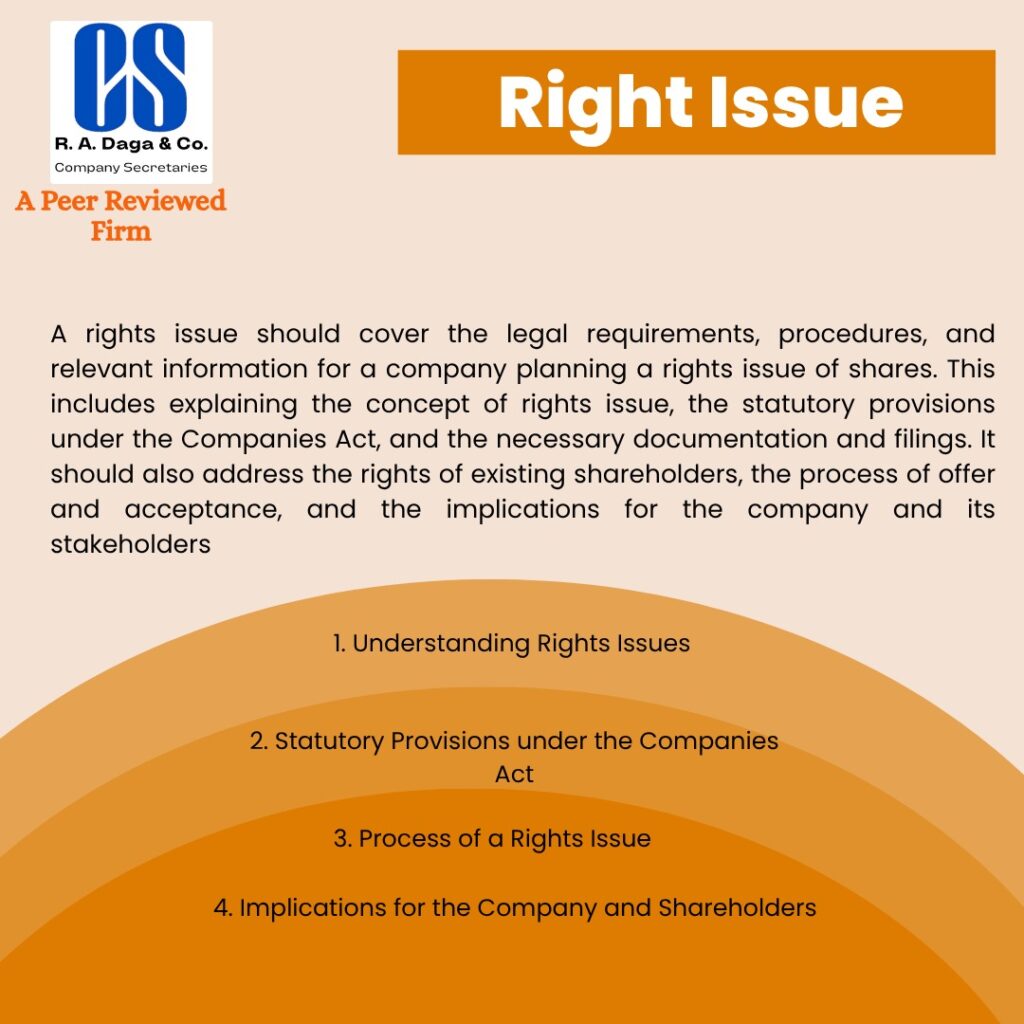
In the dynamic world of corporate finance, companies often seek efficient, compliant, and shareholder-friendly avenues to raise funds. One such effective method is a Rights Issue. As a Company Secretary Firm, we frequently guide our clients through the legal and procedural intricacies of a Rights Issue under the Companies Act, 2013 and SEBI (ICDR) Regulations, ensuring a smooth and compliant capital-raising process.
What is a Rights Issue?
A Rights Issue refers to an offer made by a company to its existing shareholders to subscribe to additional shares in proportion to their current holdings, typically at a discounted price. This method ensures that the current ownership structure is maintained while raising necessary funds for business expansion, debt reduction, or working capital needs.
Legal Framework
Rights Issue is primarily governed by the following:
- Section 62(1)(a) of the Companies Act, 2013
- Rule 13 of the Companies (Share Capital and Debentures) Rules, 2014
- SEBI (ICDR) Regulations, 2018 for listed companies
Key Features of a Rights Issue
- Offer to existing shareholders only
- Price generally lower than the market price
- Renounceable or Non-renounceable – rights can be transferred or not, depending on the terms
- No requirement to issue a prospectus (unless made to the public)
- Faster and less regulatory-intensive compared to a public issue
Procedure for Unlisted Companies
- Board Meeting
- Approve the rights issue and fix the record date.
- Approve draft offer letter (Form PAS-4).
- Dispatch of Offer Letter
- Offer letters are sent to all existing shareholders.
- Opening of Issue
- Minimum 15 days and maximum 30 days period to accept the offer.
- Receipt of Application Money
- Application money is collected in a separate bank account.
- Allotment of Shares
- Shareholders who accepted the offer are allotted shares.
- Filing of Return of Allotment
- File Form PAS-3 with the Registrar of Companies within 30 days of allotment.
- Updating Registers
- Update the Register of Members and issue share certificates.
Key Compliance Considerations for Company Secretaries
As a professional, a Company Secretary plays a pivotal role in:
- Drafting board resolutions and offer letters
- Ensuring compliance with timelines under Section 62
- Coordinating with bankers, legal counsel, and shareholders
- Filing ROC forms (PAS-3) and maintaining statutory registers
- Advising on FEMA regulations, if shareholders are non-residents
- Ensuring that the offer does not amount to a public offer inadvertently
Benefits of Rights Issue
- Cost-effective fundraising method
- Maintains control with existing shareholders
- Fewer regulatory hurdles compared to other options
- Demonstrates shareholder trust and promoter commitment
Common Mistakes to Avoid
- Non-compliance with the time window for the offer
- Delay in filing PAS-3 leading to additional fees or penalties
- Offering to non-shareholders inadvertently
- Lack of clarity in offer terms (renunciation, pricing, ratio)
Conclusion
A Rights Issue, when executed with proper planning and compliance, can be a powerful tool for corporate growth. Company Secretaries play an essential role in ensuring that the process is executed in line with the applicable legal framework and without any procedural lapses. Our firm stands equipped to provide end-to-end support in managing Rights Issues, from documentation to post-allotment compliances.
For any assistance related to Rights Issue filings, drafting, or procedural queries, feel free to reach out to us [Contact No:-8087064602] EMAIL:- csradaga@yahoo.in for expert guidance and professional incorporation services..