
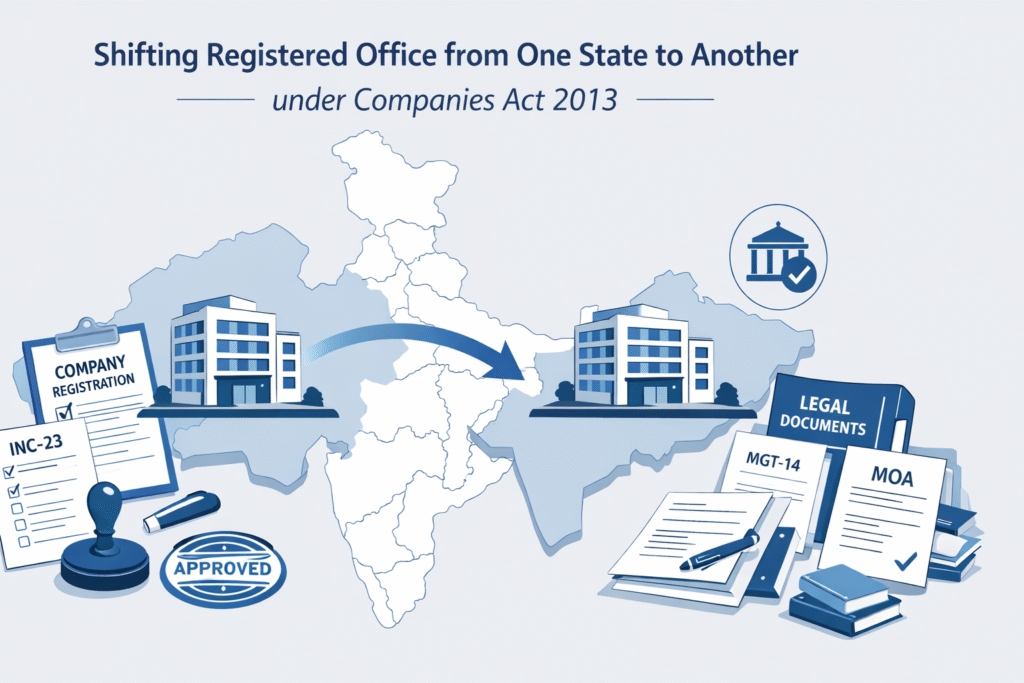
Introduction: Shifting Registered Office from One State to Another
Every company registered in India must maintain a registered office address as per the Companies Act, 2013. This address acts as the official communication point for government authorities, regulators, and stakeholders. However, businesses often expand or relocate operations to different states for strategic reasons such as tax benefits, operational efficiency, or market access.
In such situations, companies may need to shift their registered office from one state to another. Unlike a simple address change within the same city or state, this process involves alteration of the Memorandum of Association (MOA) and approval from the Regional Director of the Ministry of Corporate Affairs (MCA).
Therefore, understanding the procedure for shifting registered office Companies Act 2013 becomes essential to ensure legal compliance and avoid penalties.
Our experts at R A Daga and Co., a professional company secretary firm, explain the step-by-step procedure, required documents, regulatory approvals, and compliance requirements for shifting a registered office from one state to another in India.
What is Shifting Registered Office from one state to Another?
Shifting registered office from one state to another means relocating the official registered address of a company from one state jurisdiction to another.
This change impacts the state mentioned in the Memorandum of Association. Consequently, the company must alter the MOA and obtain approval from the Regional Director of the Ministry of Corporate Affairs.
Under the registered office change Companies Act 2013, such relocation is governed primarily by:
- Section 12 of the Companies Act, 2013
- Section 13 Companies Act registered office change provisions
- Companies (Incorporation) Rules, 2014
As a result, companies must follow a structured compliance procedure before implementing the relocation.
Why Do Companies Change Registered Offices to Another State?
Companies may decide to change registered office to another state for several business and strategic reasons.
1. Business Expansion
When companies expand operations to a new state, shifting the registered office can help centralize operations.
2. Better Infrastructure
Some states provide better infrastructure, logistics facilities, or industry clusters.
3. Tax or Policy Benefits
State governments often offer incentives for certain industries, making relocation attractive.
4. Operational Efficiency
Businesses sometimes relocate headquarters to improve operational efficiency and management control.
5. Strategic Market Access
Moving to another state may bring companies closer to customers, suppliers, or investors.
Legal Provisions for Registered Office Change under Companies Act 2013
The registered office change in the Companies Act 2013 framework requires compliance with specific legal provisions.
Section 12 – Registered Office of Company
Section 12 mandates that every company must maintain a registered office capable of receiving official communication.
Section 13 – Alteration of Memorandum
When a company moves its registered office from one state to another, it must alter the state clause of the MOA. Therefore, MOA alteration for registered office change becomes mandatory.
Role of the Regional Director
Since the MOA is being altered, the company must obtain Regional Director approval for registered office change before implementing the relocation.
Step-by-Step Procedure for Shifting Registered Office Companies Act 2013
Below is the complete procedure for shifting registered office Companies Act 2013.
Step 1: Conduct Board Meeting
First, the company must conduct a board meeting to approve the proposal for shifting the registered office to another state.
The board resolution typically includes:
- Approval for shifting the registered office
- Authorization to alter the MOA
- Approval to convene an Extraordinary General Meeting (EGM)
Step 2: Hold Extraordinary General Meeting (EGM)
Next, the company must hold an Extraordinary General Meeting to obtain shareholder approval.
The shareholders must pass a special resolution approving:
- MOA alteration
- Shifting of registered office
Step 3: File MGT-14 with ROC
After passing the special resolution, the company must complete MGT-14 filing for registered office change.
Form MGT-14 must be filed with the Registrar of Companies within 30 days of passing the resolution.
Documents attached with MGT-14 include:
- Certified copy of special resolution
- Notice of EGM
- Explanatory statement
Step 4: File INC-23 Application
Once MGT-14 is filed, the company must submit INC-23 form for registered office change to the Regional Director.
This application seeks approval for shifting the registered office to another state.
The application must include several supporting documents and declarations.
Step 5: Publish Public Notice
After filing INC-23, the company must publish a public notice regarding the proposed relocation.
The notice must be published in:
- One English newspaper
- One vernacular newspaper of the registered office state
This step ensures that stakeholders and creditors can raise objections if necessary.
Step 6: Submit Objection Report
The company must submit an affidavit confirming that:
- Creditors have been informed
- No objections remain unresolved
If objections exist, they must be settled before approval.
Step 7: Obtain Regional Director Approval
The regional director examines the application and supporting documents.
If the application is satisfactory, the authority grants Regional Director approval for registered office change.
Step 8: File INC-28 with ROC
After approval, the company must file INC-28 with the Registrar of Companies within 30 days.
This filing records the order of the Regional Director.
Step 9: File INC-22 for Address Change
Finally, the company must file INC-22 form registered office change with the new address details.
Once approved, the registered office is officially relocated.
Documents Required for Registered Office Change
Proper documentation is essential for successful compliance.
Below are the key documents required for registered office change:
- Board Resolution approving relocation
- Special Resolution passed in EGM
- Altered Memorandum of Association
- List of creditors and debenture holders
- Affidavit verifying creditor list
- Newspaper publication notice
- Proof of new registered office address
- NOC from property owner
- Lease agreement or ownership proof
Professional assistance from a Company Secretary firm like R A Daga and Co. helps ensure accurate documentation and faster approvals.
Timeline for Registered Office Change India
The timeline for registered office change India varies depending on regulatory approvals and documentation.
Generally, the process takes approximately:
|
Stage |
Estimated Time |
|
Board Meeting & EGM |
1–2 weeks |
|
MGT-14 Filing |
1 week |
|
INC-23 Application & Review |
4–6 weeks |
|
Regional Director Approval |
3–4 weeks |
|
Final ROC Filings |
1 week |
Overall Timeline
The complete process typically takes 8–10 weeks.
However, delays may occur if objections are raised or documentation is incomplete.
Cost of Shifting Registered Office to Another State
The cost of shifting registered office to another state depends on several factors.
Typical expenses include:
Government Fees
MCA filing fees for forms such as:
- MGT-14
- INC-23
- INC-28
- INC-22
Professional Fees
Professional assistance from a Company Secretary or compliance expert.
Newspaper Publication Charges
Mandatory public notice publications.
Documentation and Legal Costs
Therefore, companies should plan budgets carefully before initiating the relocation.
Consulting a professional firm like R A Daga and Co. ensures cost efficiency and compliance.
Compliance Risks to Avoid
Companies must avoid common compliance mistakes during the relocation process.
Incomplete Documentation
Missing documents often delay approval.
Incorrect Form Filing
Errors in forms such as INC-23 or MGT-14 can lead to rejection.
Ignoring Creditor Approvals
Creditors must be properly notified.
Delayed ROC Filings
Failure to meet timelines may result in penalties.
Professional compliance support significantly reduces these risks.
How R A Daga and Co. Can Help
Shifting registered offices between states involves complex legal and regulatory procedures.
At R A Daga and Co., a professional company secretary firm, we provide end-to-end compliance services, including:
- Legal advisory for registered office relocation
- Drafting board resolutions and special resolutions
- MGT-14 filing for registered office change
- INC-23 application preparation
- Coordination with the Regional Director
- Documentation and compliance management
- ROC filings, including INC-22 and INC-28
Our experts ensure fast approvals, full compliance, and minimal disruption to business operations.
Conclusion
Relocating a company’s registered office to another state is a significant corporate decision. Since the process involves MOA alteration, regulatory approvals, and multiple ROC filings, companies must carefully follow the procedure for shifting registered office Companies Act 2013.
From board approvals to Regional Director approval for registered office change, each step requires precise documentation and compliance.
Therefore, companies should seek expert guidance to ensure a smooth transition.
If your company plans to change registered office to another state, professional support from R A Daga and Co. can simplify the entire process.
Our experienced Company Secretaries ensure accurate filings, faster approvals, and complete compliance with the Companies Act 2013.
Call us now: +91 80870 64602 or visit radaga.in/contact-us for quick assistance.