

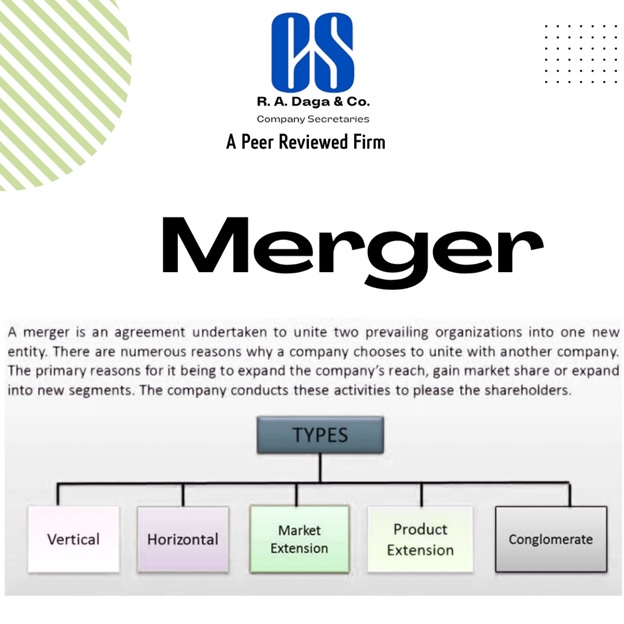
What is a Merger?
A merger is the combination of two or more companies into a single entity. One of the merging companies survives, and the other ceases to exist. The surviving company assumes the assets and liabilities of the absorbed entity.
Legal Provisions for Mergers under Companies Act, 2013
Sections 230 to 232 – Compromise, Arrangement, and Merger
These sections govern:
- Mergers and amalgamations
- Demergers
- Corporate restructuring
- Schemes between a company and its shareholders or creditors
Section 233 – Fast-Track Merger
Introduced to ease the merger process for certain categories of companies, avoiding the time-consuming NCLT route.
Section 234 – Cross-Border Mergers
Allows Indian companies to merge with foreign companies in notified jurisdictions, subject to RBI approval.
Types of Mergers Recognized
- Horizontal Merger – Companies in the same industry
- Vertical Merger – Companies in a supply chain
- Conglomerate Merger – Companies in unrelated businesses
- Reverse Merger – A subsidiary merges into its parent or a small company merges into a larger one
Fast-Track Merger – Section 233
Eligibility:
- Two or more small companies
- Holding company and wholly-owned subsidiary
- Start-ups, or a start-up and small company
- Unlisted companies with borrowing up to ₹50 crore and no defaults (as per recent updates)
Key Benefits:
- No need for NCLT approval
- Simpler and faster procedure
- Lower cost and compliance burden
Step-by-Step Merger Procedure
1. Board Approval
- Draft the Scheme of Merger
- Convene Board Meetings to approve the scheme
2. Valuation Report
- Obtain a report from a registered valuer
3. Application to NCLT (if applicable)
- Apply in Form NCLT-1 along with the scheme
4. Meetings of Shareholders and Creditors
- Convene meetings and seek approval (majority in number and 3/4th in value)
5. Approval from Regulatory Authorities
- File with ROC, Official Liquidator, SEBI, RBI (if required)
6. Filing with NCLT or Regional Director
- NCLT approval for regular merger
- Regional Director approval for fast-track merger
7. Final Orders and Filings
- File the approved scheme and order with ROC using Form INC-28
Key Forms Involved
Form No. | Purpose |
CAA-1 | Application to NCLT/Regional Director |
CAA-9 | Declaration of Solvency |
MGT-14 | Filing resolutions |
INC-28 | Filing order with ROC |
Role of Company Secretary in Mergers
A Company Secretary plays a pivotal role in the merger process:
- Ensuring compliance with legal procedures
- Drafting scheme and board/shareholder resolutions
- Liaising with legal advisors, valuers, and regulators
- Managing ROC/NCLT filings
- Advising the Board on strategic implications
- Communicating with shareholders and creditors
Key Takeaways from Recent Amendments (2024–2025)
- Fast-track merger now includes more types of unlisted companies
- Borrowing threshold set at ₹50 crore with no default condition
- Cross-border mergers simplified with RBI pre-approval windows
- Valuation reports and auditor certifications made mandatory for all merger types
Conclusion
The merger process under the Companies Act, 2013 has evolved to become more structured, transparent, and business-friendly. The Company Secretary is the compliance anchor, ensuring that every step—from drafting the merger scheme to final ROC filings—is accurate and within the law.
In a rapidly changing regulatory environment, it’s essential for CS professionals to stay informed, compliant, and ready to guide corporate strategies through mergers and restructuring.