

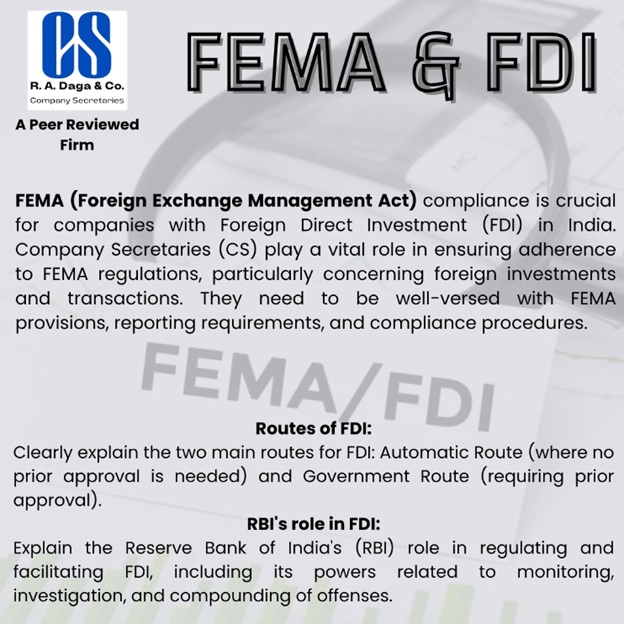
What is FEMA and FDI – A Quick Recap
FEMA governs foreign exchange transactions in India and provides the legal framework for all inbound and outbound foreign currency-related dealings.
FDI refers to investments made by a foreign entity into an Indian business. These investments are either made under:
- Automatic Route – No prior government approval is needed.
- Government Route – Prior approval from the concerned ministry is required.
Both FEMA and the FDI Policy are continuously reviewed to adapt to global economic trends and national priorities.
- Amendment in FDI Limits for Certain Sectors
- Space Sector: Up to 74% FDI allowed under the Automatic Route in satellite manufacturing and launch vehicle services.
- Insurance & Pension Funds: FDI limit increased from 49% to 74% under Automatic Route (with safeguards).
- Defence Manufacturing: Up to 74% FDI under Automatic Route; beyond that under Government Route, subject to security clearance.
- FEMA (Non-Debt Instruments) (Third Amendment) Rules, 2024
- Clarification on “Beneficial Ownership” in line with the Companies Act and Prevention of Money Laundering Act (PMLA).
- New compliance timelines for FDI reporting on the FIRMS portal, with stricter penalties for delays.
- Introduction of online validation systems for Know Your Customer (KYC) norms for foreign investors.
- Investment from Countries Sharing Land Border with India
- Any FDI from countries sharing land borders with India (including indirect investments) must get prior government approval.
- Even if the beneficial owner is from such a country, the investment route will be deemed under the Government Route.
- Single Master Form (SMF) Compliance Updates
- The RBI has upgraded the SMF system to include auto-reconciliation features.
- Delays in submission of FC-GPR, FC-TRS, and DRR forms can now attract automatic show-cause notices via email alerts.
Role of Company Secretaries in FEMA/FDI Compliance
With frequent policy changes, Company Secretaries play a vital role in:
- Advising clients on sector-specific FDI limits
- Preparing and reviewing documents for RBI and MCA compliance
- Filing forms like FC-GPR, FC-TRS, and LLP-I/II
- Ensuring compliance with pricing guidelines and valuation norms
- Monitoring timelines to avoid penal consequences under FEMA
Final Thought
FEMA and FDI regulations are no longer just legal formalities—they are strategic pillars of corporate governance. As India opens its doors wider to foreign investors, the role of Company Secretaries becomes more critical in interpreting amendments, ensuring strict compliance, and guiding businesses through an evolving regulatory environment.
Are you facing challenges in FDI compliance or FEMA filings?
Let Company Secretary assist you with end-to-end regulatory support.