

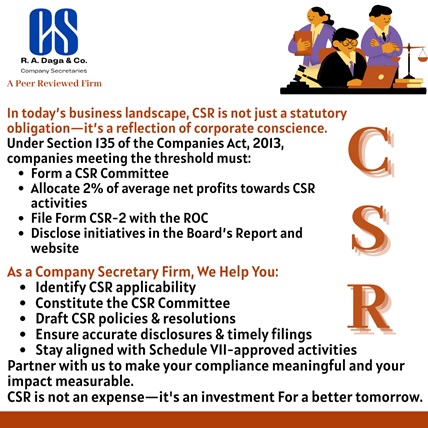
Corporate Social Responsibility (CSR) isn’t just a moral obligation—it’s now a legal one under Section 135 of the Companies Act, 2013. Companies meeting specified thresholds (net worth ≥ ₹500 cr, turnover ≥ ₹1,000 cr, or net profit ≥ ₹5 cr) must spend at least 2% of average net profit of the past three years on CSR projects.
In recent years, the Ministry of Corporate Affairs (MCA) has rolled out key updates to ensure stronger governance, transparency, and impact.
1. Mandatory Impact Assessment
Companies with average CSR spend ≥ ₹10 cr over the past 3 years must conduct an independent impact assessment for any completed project with a budget of ≥ ₹1 cr
The cost of this assessment is capped at the lower of ₹50 lakh or 5% of total CSR expenditure. As per 2022 rules, it’s now the lower of ₹50 lakh or 2%
2. Enhanced Governance & Disclosures
- CSR Committee:-Mandatory for companies exceeding CSR thresholds.
- Required even if spend ≤ ₹50 lakh but only if there are unspent funds from multi-year projects
- CSR Policy and Annual Action Plan must be publicly disclosed on the company’s website, covering project list, monitoring mechanism, timelines, and impact assessment details
- The CFO (or financial head) must certify proper utilisation of CSR funds .
3. Caps & Accountability
- Administrative overheads, like salaries and office expenses, are capped at 5% of total CSR expenditure.
- Penalties:
- Company: up to ₹1 cr or twice the unspent CSR amount, whichever is less.
- Officer in default: up to ₹2 lakh or 10% of the unspent amount.
4. Broader Scope & Implementation Options
- Eligible implementation agencies expanded (since Sep 2022) to include:
- Section 8 companies, charitable trusts, societies (under specified Income Tax exemptions), and public authorities with 3+ years of demonstrated work Companies must transfer unspent funds within 6 months post-financial year either to an ongoing project account or funds specified in Schedule VII
Why These Amendments Matter
- Impact measurement promotes accountability and ensures funds are used effectively.
- Transparency in governance boosts stakeholder confidence.
- Stricter penalties underscore the importance of compliance.
- Broader agency options allow collaboration with experienced NGOs and trusts to maximize social benefits.
Role of a Company Secretary (CS)
A CS plays a central role in CSR compliance:
- Structuring the CSR Committee and drafting the annual action plan.
- Implementing governance mechanisms, including website disclosures and CFO certification.
- Coordinating impact assessment with independent agencies for large projects.
- Ensuring timely transfer of unspent CSR funds to appropriate accounts.
- Advising on selection of credible and effective implementation agencies.
- Preparing annual CSR reports, aligned with updated annexure formats and Rules
Final Thoughts
CSR is not just a legal requirement—it’s an opportunity for companies to create meaningful social and environmental impact. With the latest MCA updates, compliance is more transparent, accountable, and outcome-driven.
As a Company Secretary, you’re well-positioned to guide companies in:
- Structuring robust CSR policies
- Ensuring full statutory compliance
- Driving strategic initiatives with measurable social returns
Need Expert CSR Advisory?
We offer comprehensive CSR services—policy drafting, committee setup, impact assessment liaison, compliance reporting, and more.
[Contact no:-8087064602] to elevate your CSR journey.